

What does the project involve?
Prof. Beata Gutarowska: For many years, I have been working on biodeterioration of heritage objects, meaning the degradation of materials caused by microorganisms. Teresa’s doctoral research also focused on the microbial degradation of historical audiovisual materials, so our scientific interests naturally aligned. She also recognized that Lodz University of Technology is one of the leading centers worldwide in material and microbiological research related to heritage conservation.
The research began in mid-April. The project involves cooperation with Polish museums, including the Auschwitz-Birkenau Museum in Oświęcim, where I have been conducting research for years, as well as institutions in Lodz. Teresa has also taken an interest in our 19th-century Art Nouveau buildings and historic palaces located on the university campus. Many of these structures struggle with biodeterioration. Part of her fellowship will also be carried out at Rzeszów University of Technology in collaboration with Prof. Tomasz Ruman.
What makes the project innovative?
The project addresses a very specific problem that has emerged in recent years. Under European Union regulations, many substances previously used to protect heritage objects are being withdrawn.
Why?
Some of these compounds have proven toxic to both the environment and humans. They may disrupt biological processes in soil and water, accumulate in living organisms, and negatively affect human health. As a result, conservators now have a much more limited selection of effective agents for disinfection and protection. In the case of anti-algae treatments, the number of available substances is already very limited.
And this is where the concept of the idea comes in?
Yes. The goal is to develop compounds that are both effective and safe—for the environment, for people, and for the heritage materials themselves. This is crucial, as protective agents must not further damage delicate historical materials.
The project seeks a balance: protecting both the environment and cultural heritage while effectively inhibiting the growth of microorganisms responsible for biodeterioration.
That sounds very up-to-date.
We draw inspiration from nature. There is increasing talk these days about utilising solutions developed by nature. Of course, we still need to be able to translate these natural mechanisms into specific technological solutions – and that is precisely what we are trying to do.
Our aim is to create so-called ‘green biocides’ for the protection of technical and historic materials — eco-friendly products that are both effective and safe for the environment and people.
What are biocides?
Biocides are substances that inhibit the growth of microorganisms on technical materials. They can be added during the production stage of the material – for example, to building materials – and actively prevent the growth of microorganisms when favourable conditions arise.
Another method of application is the disinfection of existing surfaces. If a material has become colonised by microorganisms, biocides are used in the form of solutions that remove the biofilm from the surface.
Are the currently used biocides natural?
No, currently synthetic solutions dominate. And this is exactly where our innovation appears. We propose ecological solutions — that is why we tentatively call them “green solutions.” We want to use substances of natural origin: plant extracts and compounds produced by microorganisms themselves.
Are microorganisms supposed to fight other microorganisms?
Exactly so. In nature, there is constant competition between microorganisms. Some microorganisms are able to inhibit the growth of others, thanks to which they gain an advantage and can colonize a given environment. It is enough to look at antibiotics - they are also produced by microorganisms.
We are trying to use these mechanisms in the protection of monuments. We have already collected about 70 strains of microorganisms isolated from various environments, among others from museums. Then we prepare them appropriately - we remove active cells, and we use what remains after cultivation, that is the so-called post-ferment.
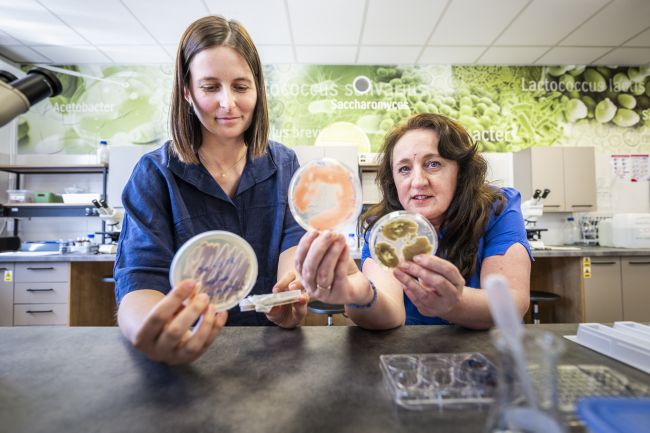
And it is this post-ferment that is supposed to act protectively?
Yes, but first it has to be properly developed. We want to place these substances in special films or microcapsules that will gradually release active compounds inhibiting the development of undesirable microorganisms.
We work similarly with plant extracts. Teresa has already conducted research on a dozen or so plant species available in Poland and obtained very promising results. My team has also previously published studies showing that some plant extracts effectively inhibit the development of algae or fungi on technical materials. Our portfolio already includes several such extracts.
What will the next stages of the research look like?
First, we test everything under laboratory conditions — on brick, wood, paper and other sensitive materials. We already have prepared samples of materials overgrown with microorganisms. Later, we will develop appropriate forms of application of these substances.
These may be aerosols, special liquids or alginate-chitosan films containing microcapsules. Such material will be able to be applied to the surface of a monument for a specified time, for example for a day, and then removed.
How do such microcapsules work?
It can be said that they are intelligent. Under conditions of increased humidity, they will gradually open and release active substances over a longer time. Thanks to this, the protective effect is to be more durable and effective.
I understand that the research concerns not only effectiveness against microorganisms? This is very important for us. We must check not only whether the preparations effectively remove biofilm and inhibit the development of microorganisms, but also whether they are safe for the monument materials themselves. Some plant extracts not only inhibit the growth of algae, but also cause the disappearance of their pigments. Thanks to this, the material regains its natural color and appearance. We therefore study the impact on color, structure or strength of materials. This is one of the most promising results of our work. For conservators, this is an absolutely fundamental issue.
What makes these solutions potentially more effective than traditional biocides?
The key is that we are dealing not with a single chemical compound, but with whole mixtures of active substances. In plant extracts or post-ferments there are many different compounds acting simultaneously on different mechanisms of microorganism functioning. Therefore, we expect a stronger inhibitory effect than in the case of classic, single synthetic biocides. And the first results indeed confirm this.
What next?
In situ studies will allow us to check the effectiveness of our solutions in various environmental conditions. We want to observe how natural biocides behave throughout the year. Such studies are practically not yet conducted in the world.
And what is to be the final result of the project?
First of all, we want to create specific procedures for conservators. Ultimately, we aim to develop a ready product — or even several products — and a technology for preparing appropriate materials. The simpler and more practical the technology, the better.
Scientific publications will be an added value, as will participation in international conferences. An important goal of the project is also the scientific development of Dr Teresa Branysová and enriching her research experience.
The project probably also has an additional dimension, not only strictly scientific?
Definitely yes. It is an engineering and technical project, but an enormous added value is also soft skills. We want to show young doctoral students and future PhD candidates how to prepare such projects and effectively apply for grants. We already know that further international consortia of young scientists are being formed, which together with our university plan to apply in the next edition of the programme. We want to share experience and show how to achieve success.
You mentioned earlier the significant help of the Research Support Centre in preparing the project. It was extremely important. I would especially like to emphasize the role of two ladies — Director Agnieszka Dybała-Dyfraktyka and Agnieszka Tiele. Their support had a large share in this success. Particularly valuable were the internal reviews of the project organized by the Center. Experts were involved in the work who had themselves previously obtained Marie Skłodowska-Curie Fellowship grants or had been reviewers of these projects.
So it was a success of the whole team?
Definitely yes. It is a success of many people. Of course, the basis was a good scientific concept, but equally important was the appropriate presentation of the project’s potential.
Interview by Ewa Chojnacka