
Nature recognises the shape of molecules with remarkable precision. This fundamental property of the living world is associated with its chirality, which arises from the structure of molecules that can exist in two non-superimposable spatial forms related to one another as an object and its mirror image—much like the left and right hands. This seemingly subtle difference in the spatial arrangement of atoms often determines a compound’s biological activity, its smell and taste, and, above all, its therapeutic effects.
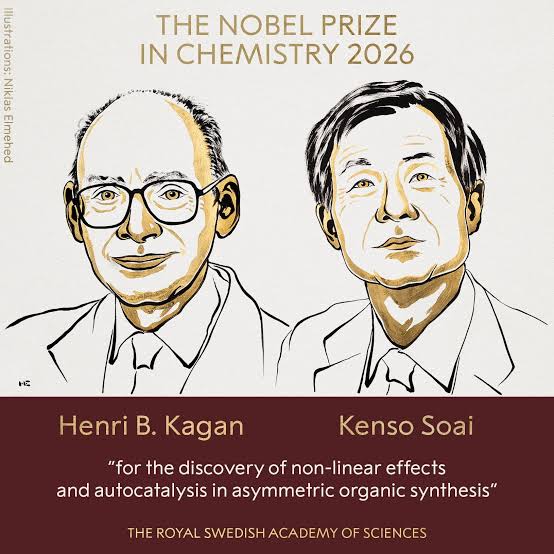
The significance of chirality is exemplified by the scientific achievements of this year’s Nobel laureates, who demonstrated how a slight excess of one of a compound’s mirror-image forms can be amplified and subsequently come to dominate the course of a reaction almost entirely. Kagan’s and Soai’s discoveries have not only advanced methods of asymmetric organic synthesis but have also brought chemists closer to solving one of science’s most fascinating mysteries: why the biomolecules that make up living organisms occur predominantly in just one of the many possible spatial forms.
The achievements of this year’s laureates illustrate a fruitful convergence of two fundamental strands of modern organic chemistry: the development of useful synthetic methods and the search for answers to questions about the origins and organisation of living matter. The nonlinear effects discovered by Kagan help chemists understand the mechanisms of asymmetric catalysis and optimise reactions that yield products of high enantiomeric purity.
Soai’s asymmetric autocatalysis, meanwhile, demonstrated that a chemical system can, on its own, recognise, replicate and preserve an initially very slight asymmetry. This does not, of course, amount to directly recreating the processes that occurred at the origins of life. Nevertheless, the Soai reaction provides a model showing how a small departure from symmetry could have become established at the molecular level.
Asymmetric synthesis has also been an important area of research at the Faculty of Chemistry at Lodz University of Technology for many years. This research encompasses the development of methods for selectively producing chiral compounds and the investigation of the mechanisms responsible for controlling their spatial configuration.
The concept of nonlinear effects, together with the possibility of amplifying a small initial asymmetry through autocatalytic processes, has been—and remains—an important source of inspiration for researchers at the Institute of Organic Chemistry. The 2026 Nobel Prize in Chemistry therefore holds special significance for Łódź’s chemistry community. It reminds us that, in the world of molecules, even the smallest difference can be of fundamental importance, and that basic research into the mechanisms of asymmetric reactions can lead both to a better understanding of how matter is organised and to the development of practical methods for synthesising compounds with useful applications.