In 2005, the European Commission published European Charter For Researchers and the Code of Conduct for the Recruitment of Researchers as recommendations for researchers, research institutions and organisations funding science in the public and private sectors. Their purpose was to improve the research environment and working conditions in research.
Adopted in 2005, the European Charter for Researchers described the rights and obligations applicable to researchers, the institutions employing them, and organisations providing funding for scientific research. The Code of Conduct for the Recruitment of Researchers described the principles for recruiting researchers which employer institutions should observe, ensuring equal treatment of all researchers in the recruitment process. Both documents contained forty principles defining the HRS4R process. In January 2024, the European Commission adapted the content of the European Charter for Researchers to current challenges and a changing environment. The new document, the The New Charter for Researchers, contains twenty principles and replaced both of the above-mentioned documents.
With a view to ensuring a high-quality working environment and scientific research, as well as recognising the value of the work performed by researchers, Lodz University of Technology decided in 2012 to begin the process of implementing the provisions of the Charter and the Code by submitting a declaration of support for the principles set out in these documents.
An internal analysis conducted at our University showed that most national regulations, internal rules and good practices in place at Lodz University of Technology complied with the principles of the European Charter for Researchers and the Code of Conduct for the Recruitment of Researchers. However, in areas considered particularly important from the University’s perspective and for the purpose of implementing the provisions of these documents, the HR Strategy for Researchers was prepared in 2016. It included an Action Plan for 2016–2018 and the Human Resources Development Policy at Lodz University of Technology (strategy promotional poster).
Following an external assessment, in May 2016 the European Commission (EC) decided to award Lodz University of Technology the HR Excellence in Research Award. Lodz University of Technology was the first technical university and the third institution in Poland to be distinguished by the EC. This highlighted the importance of the strategy adopted by Lodz University of Technology and the planned HR activities, confirming the University’s commitment to implementing the European Charter for Researchers and the Code of Conduct for the Recruitment of Researchers.
In 2018, Lodz University of Technology reviewed the two-year implementation period of the HR Strategy for Researchers. Representatives of researchers employed at the University and representatives of the University’s administrative units were involved in preparing the report on the implementation of activities carried out in 2016–2018. The outcome of this work was the Internal Review. As part of the undertaken activities, open consultations were conducted, resulting in the development of the Action Plan for 2018-2021 and the update of the Human Resources Development Policy at Lodz University of Technology. These documents received favourable opinions from the Rector and the Senate of Lodz University of Technology.
As part of activities related to the implementation of the Human Resources Strategy for Researchers at Lodz University of Technology, an internal OTM-R policy (Open, Transparent and Merit-based Recruitment) was developed in spring 2018: OTM-R checklist.
In May 2018, the results of the internal self-assessment and the Action Plan for 2018–2021 were submitted to the European Commission for approval. The Steering and Monitoring Committees appointed by the Rector’s authorities were transformed into the Implementation Committee in 2018.
On 18 October 2019, Lodz University of Technology, together with the National Contact Point for EU Research Programmes, co-organised a nationwide meeting of institutions awarded the HRS4R logo. The meeting was attended by European Commission representative Michele Rosa-Clot and the Director of Centres de Recerca de Catalunya in Barcelona, Lead Assessor in the HRS4R process, Lluís Rovira Pato.
In autumn 2021, the Rector’s authorities reappointed the Steering and Monitoring Committees. The Steering Committee included heads of scientific disciplines and a doctoral student representative. The Monitoring Committee consisted of managers and employees of administrative units responsible for implementing individual HRS4R activities. Both Committees analysed the 2016 Gap Analysis and, after obtaining the opinions of the research community and doctoral students, developed a new HR Strategy for Researchers for 2022-2024, together with an Action Plan for 2022-2024. The OTM-R checklist was updated, and Order No. 80/2021 of the Rector of Lodz University of Technology of 17 December 2021 was implemented, concerning the method and procedure for conducting competitions for academic teacher positions at Lodz University of Technology: OTM-R POLICY – OPEN, TRANSPARENT AND MERIT-BASED RECRUITMENT PROCESS. An Internal Review, i.e. an internal review of the activities of Lodz University of Technology in 2018–2021, was prepared and submitted to the European Commission in order to initiate the process of renewing the HR Excellence in Research Award.
On 16 May 2022, an online meeting (Site Visit) with European Commission assessors was held at Lodz University of Technology in order to renew its entitlement to use the HR Excellence in Research Award. Foreign experts assessed how Lodz University of Technology had implemented the adopted Action Plan and how the initiatives undertaken were perceived by the University community. The meetings were attended by the University authorities, members of the Steering and Monitoring Committees, and representatives of the research community at different stages of their research careers, including early-career researchers. In addition, the assessors were presented with the process of developing and implementing the Gender Equality Plan and with the measures undertaken to ensure equal access to employment and career development in research for both women and men.
Following the evaluation of the HR Excellence in Research process, on 17 June 2022 the experts positively assessed the measures undertaken and extended the entitlement to use the HR Excellence in Research Award for a further 36 months, until 17 June 2025.
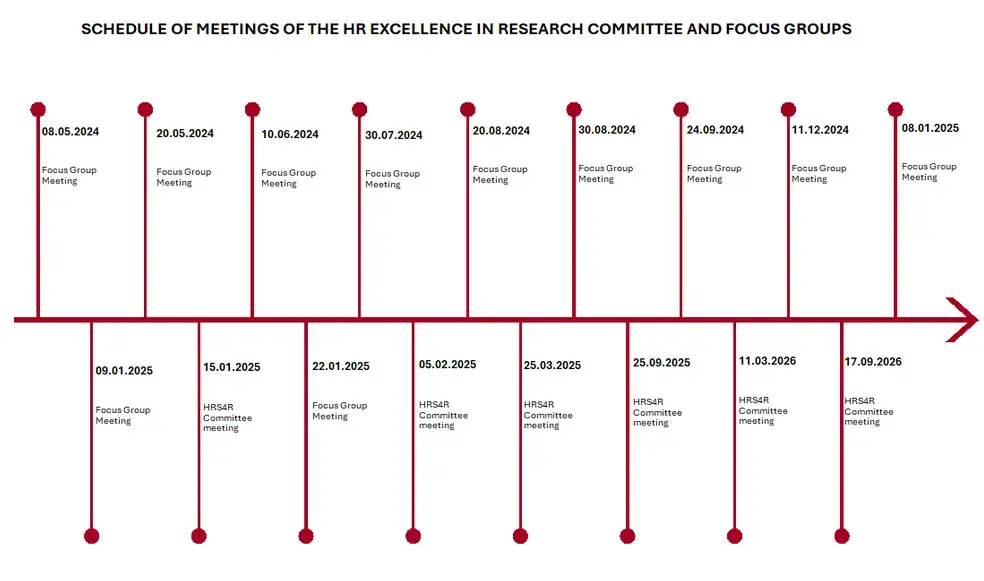
In 2022–2025, the Steering Committee and the Monitoring Committee held regular meetings devoted to monitoring the implementation of activities and preparing for the next review under the HRS4R process. To this end, work was carried out on updating the GAP Analysis and preparing a new Action Plan for 2025-2027.
As part of this process, four focus groups were established, comprising representatives of the research community and administration. The task of the groups was to analyse the individual pillars of the Charter for Researchers, identify areas requiring improvement and propose actions. A total of 37 people took part in the work of the focus groups.
Members of 12 scientific discipline councils were also involved in preparing the GAP Analysis. During the meetings, a presentation on the implementation of the HRS4R process at Lodz University of Technology was delivered. This was followed by a discussion which enabled the exchange of experience and the collection of information on the strengths of the process and areas requiring improvement. Following consultations conducted in their units and research teams, the participants also presented proposals for new activities. A total of 224 academic teachers took part in the meetings of the 12 scientific discipline councils.
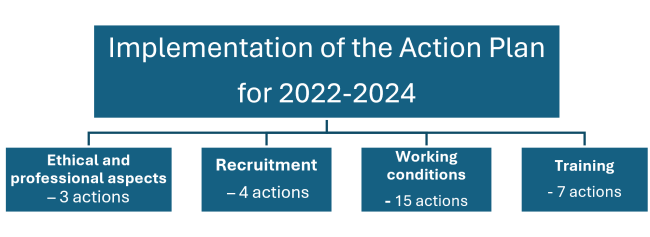
As part of the implementation of the Action Plan for 2022–2024, numerous initiatives supporting the internationalisation of research conducted at Lodz University of Technology were carried out. The Plan included a total of 29 actions assigned to four areas: 3 actions in the area of ethical and professional aspects, 4 actions in recruitment, 15 actions concerning working conditions, and 7 actions in the area of training and professional development.
Particular attention was paid to increasing the University’s openness and attractiveness as a workplace for international research staff. For this purpose, among other measures, a Welcome Point was established, providing comprehensive information, services and support to people from abroad undertaking research activities at Lodz University of Technology.
The recruitment and onboarding procedures for new research staff from Poland and abroad were improved and adapted to the requirements of the European Commission.
To facilitate the establishment of international cooperation, personal profiles containing information on specialisations, research conducted, participation in projects and publication output were created in the Information Portal. Training on the popularisation of research and scientific achievements, commercialisation and knowledge transfer, and intellectual property protection proved to be significant support for the research community.
Measures were also taken to support the development of professional competences, the formation of research teams and applications for international grants. In order to strengthen the motivation of members of the academic community, a system of awards promoting scientific excellence was introduced for research staff, students of doctoral schools and students.
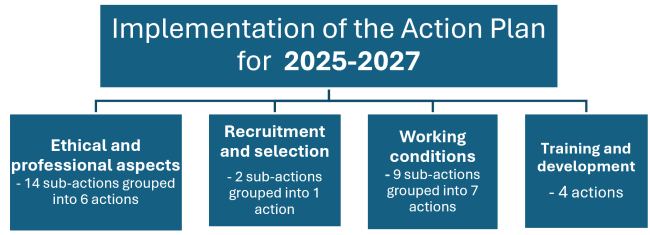
On 16 June 2025, Lodz University of Technology submitted to the European Commission an Internal Review on the implementation of activities in 2022–2024, together with the Action Plan for 2025-2027.
In September 2025, in order to ensure closer cooperation and better coordination of activities, the Rector appointed a unified HR Excellence in Research Committee for 2025–2027. Its members included individuals conducting research at career stages R1 to R4, a doctoral student representative, and representatives of administrative units involved in implementing the HRS4R process.
Within the Committee, the existing division of tasks between representatives of the research community and administrative units was retained. As in the previous organisational structure, the research community participates in initiating and monitoring activities, while administrative units are responsible for their implementation within the scope of their competences. The role of Chair of the Committee was entrusted to the Vice-Rector for Science, Professor Łukasz Albrecht, and the role of Deputy Chair to the Vice-Rector for Development, Professor Adam Wojciechowski. Meetings of the HR Excellence in Research Committee are held regularly and serve to monitor progress in the implementation of tasks provided for in the Action Plan for 2025–2027.
90-924 Lodz, Poland