

The project addresses particularly important challenges concerning the security of Ukraine’s energy infrastructure, where the power system has operated under direct threat for years. Cooperation between researchers from Lodz and Kharkiv makes it possible to combine technological expertise with experience of operating energy infrastructure in wartime and under heightened risk.
A digital twin for security
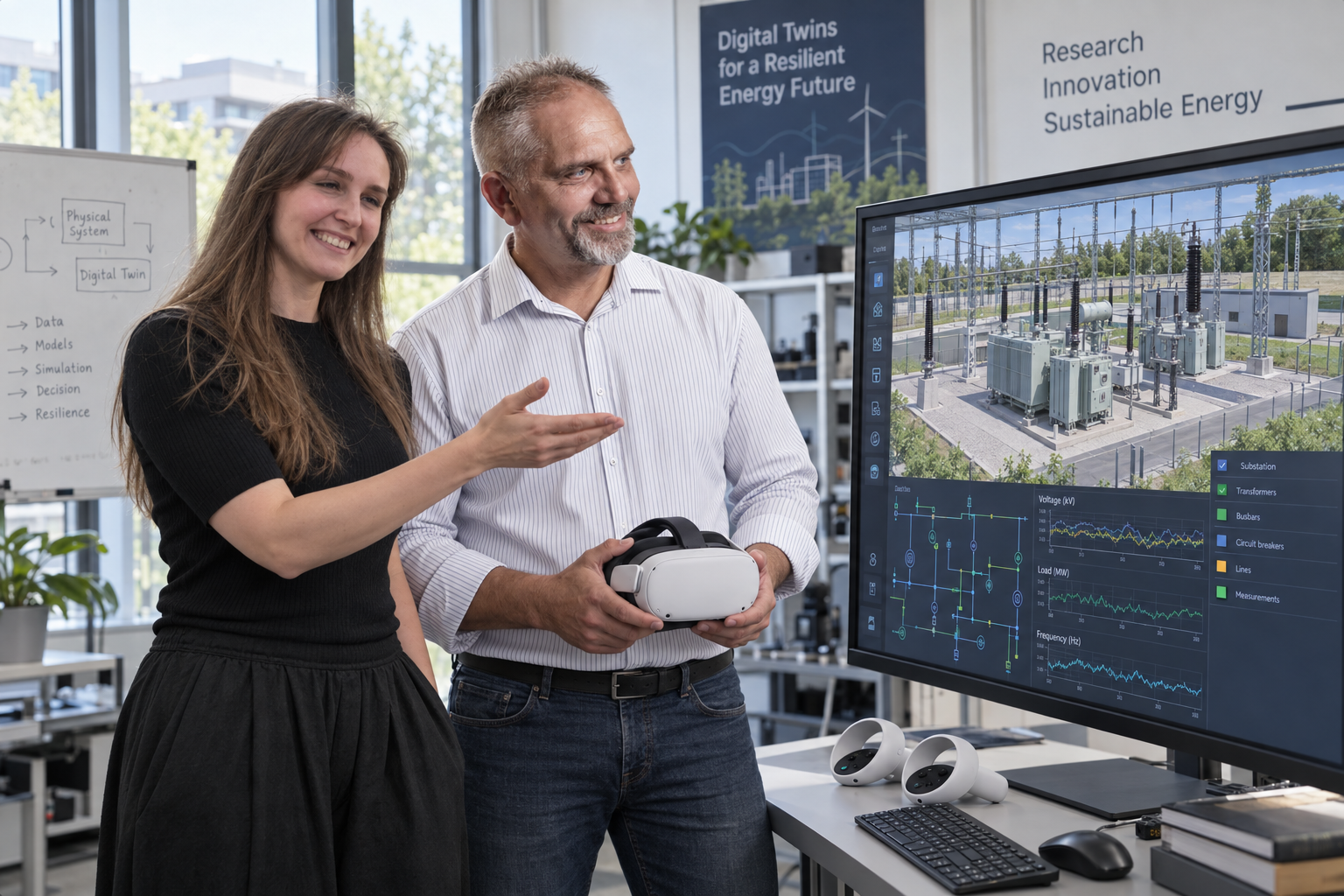
TWIN-SEC involves developing and using a digital twin of a power grid—a digital representation of selected system components—to analyse its operation, simulate emergencies and test solutions designed to improve the resilience of the infrastructure. The project combines research in power engineering, digital modelling, artificial intelligence and information technology. At Lodz University of Technology, the project is being carried out by the Voxel Research Lab, which operates within the Institute of Mechatronics and Information Systems at the Faculty of Electrical, Electronic, Computer and Control Engineering. Grzegorz Zwoliński, PhD, is the NATO Country Project Director, while Assoc. Dorota Kamińska, PhD, also participates in the team’s work. Vladyslav Pliuhin, PhD, is the project director on the Ukrainian side.
The project is scheduled to run for 36 months. During this period, a prototype digital twin will be created, threat models and scenarios will be developed, and AI-based tools for analysis and decision support will be produced. The final stage will involve integrating and demonstrating the solution under near-real-life conditions. For security reasons, historical or appropriately prepared data will be used without disclosing sensitive details about the infrastructure.
Power grids and VR
The research will cover selected components of municipal and regional power grids. An important element on the Ukrainian side will be an existing model of Kharkiv’s municipal power system, which includes a 110/35 kV substation and a dispatch control station. Lodz University of Technology will contribute its IT facilities and VR visualisation environments. Cooperation with the Lodz Energy Cluster “Fala Energii” is also planned.
TWIN-SEC is a Lodz University of Technology research initiative that combines the development of modern technologies with the practical challenges of protecting critical infrastructure. The project also strengthens scientific cooperation between Poland and Ukraine, drawing on the potential of both teams to seek solutions that make energy systems more resilient to contemporary threats.
The solutions under development are intended to provide a better understanding of how power grids behave during emergencies, predict the consequences of disruptions and identify ways of improving grid resilience. This aspect of the research—protecting the infrastructure on which society’s everyday functioning depends - is one of TWIN-SEC’s most important objectives.