professor of automation, electronics, electrical engineering and space technologies/ information and communication technology
priority research area: (Re)EnergyTech
Research achievements
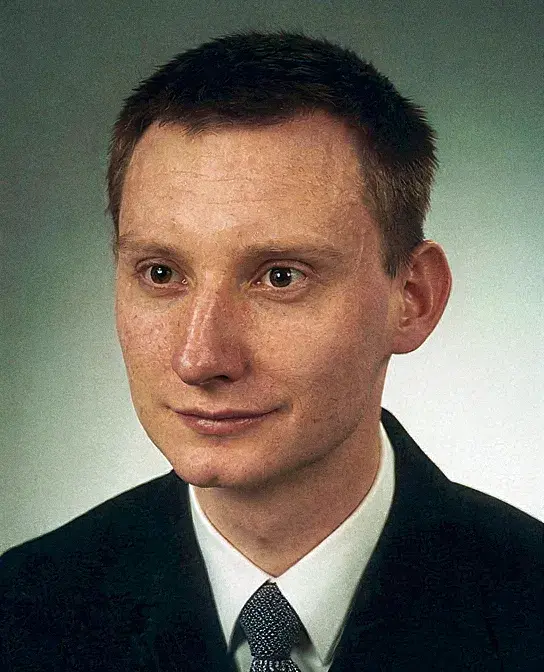
Professor Dariusz Makowski from the Faculty of Electrical, Electronic, Computer and Control Engineering at Lodz University of Technology is a key researcher whose scientific achievements, including plasma diagnostics and critical real-time control systems, directly impact the development of global fusion energy and set new standards in real-time technologies. Professor Dariusz Makowski is directly involved in strategic international projects, such as the construction of the world’s largest ITER tokamak, the Wendelstein 7-X stellarator, and the ESS accelerator. As part of his work on plasma diagnostics, he develops advanced control and data acquisition systems, which are essential for maintaining process stability under extreme conditions typical of stellarators or tokamaks. The use of artificial intelligence for infrared radiation analysis and real-time plasma diagnostics maximizes fusion pulses energy and energy yield.
Research profile and directions
Professor Makowski’s research focuses on combining electronics engineering with advanced computer science. His experience in designing high-reliability control systems is being transferred to energy-intensive sectors to reduce energy losses and increase process efficiency. The professor’s work supports the SDG goals in the areas of energy, industry, and innovation, demonstrating that advanced engineering is the foundation of a fair and efficient future economy. This work positions Lodz University of Technology as a leader in decarbonization, requiring the highest precision and technological innovation on a global scale.
Industry collaboration, implementation and expertise
Professor Makowski co-created the machine protection system for the W7-X stellarator and numerous electronic and software solutions for the ITER tokamak, and actively collaborates with centers in Germany, France, the USA, and Japan. His work is a prime example of transferring innovation from the laboratory to real-world industrial systems. The professor holds a number of responsible expert positions: he is a member of the Science Evaluation Commission and an expert of the Polish Committee for Standardization for Computer Terminology. He is also an active member of prestigious international organizations, including IEEE, RADECS, PICMG, and the IEEE Nuclear, Plasma Sciences Society, IEEE Computer Applications in Nuclear and Plasma Sciences and European Machine Vision Association.