

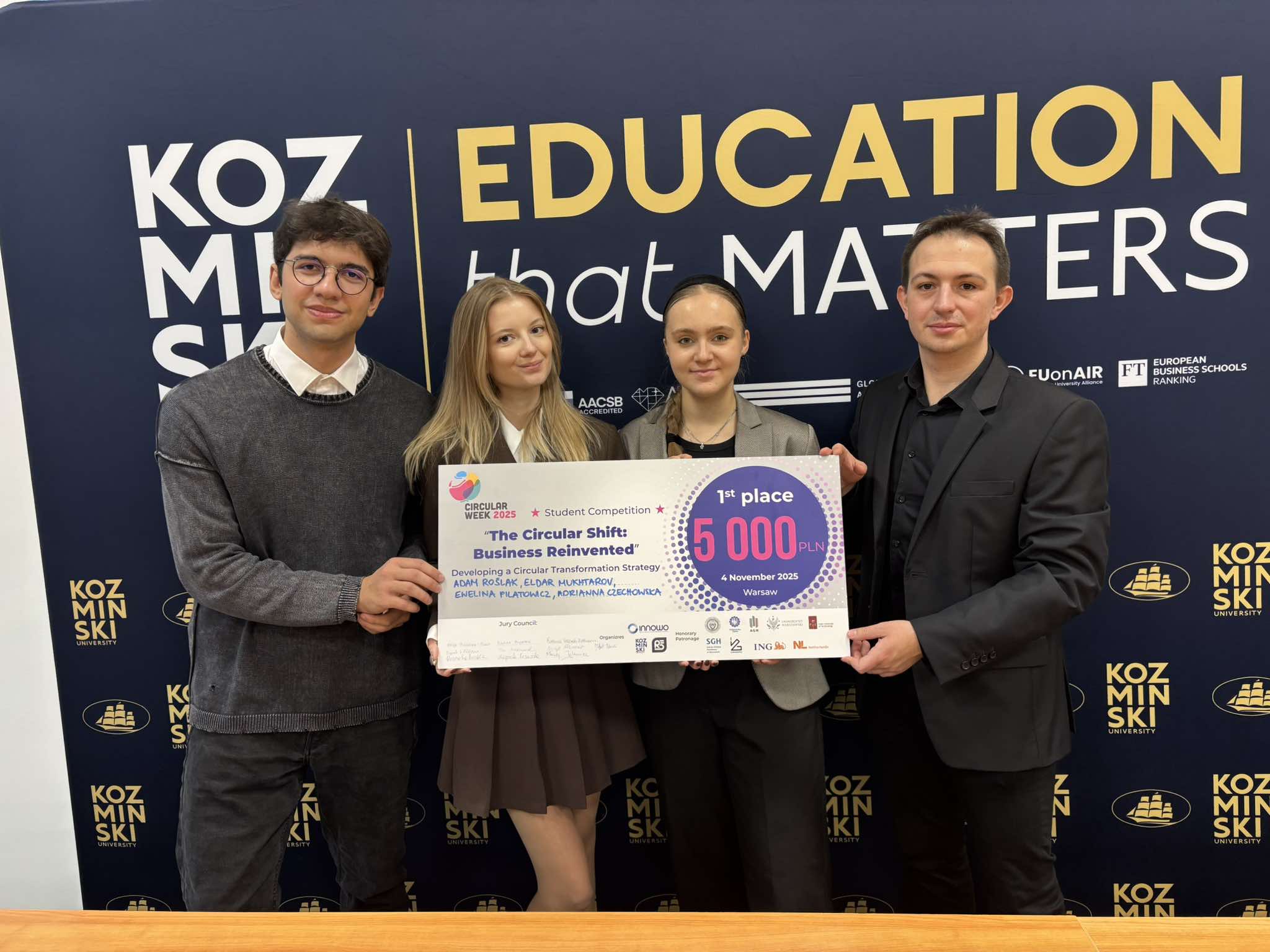
The laureates are affiliated with the International Faculty of Engineering (IFE). The international and interdisciplinary team consisted of:
• Ewelina Pilatowicz and Adrianna Czechowska – students of Biomedical Engineering and Technologies,
• Eldar Mukhtarov – student of Computer Science,
• Adam Roślak – PhD candidate in Materials Engineering at the Institute of Materials Engineering, TUL, and an IFE graduate.
Winning Project: “Circular Data Center Strategy”
The award-winning concept focused on applying the principles of the circular economy (CE) to data centers. The students proposed a comprehensive strategy to improve energy efficiency, promote resource reuse, and reduce the environmental impact of IT infrastructure.
The winning team (from right): Adam Roślak, Adrianna Czechowska, Ewelina Pilatowicz and Eldar Mukhtarov
photo: Sławomir Łaski
“Unlike many competing teams that focused on individual products or AI-supported processes, we approached the problem at its source. We designed a multi-level energy recovery system that significantly reduces the consumption of key resources—water and electricity,”
the authors explained.
They emphasized:
“Our project also included the use of renewable energy sources, which further improved its alignment with circular economy principles. We addressed not only environmental but also economic factors—presenting savings forecasts and estimated financial outcomes for data center operating companies.”
Among the environmental goals were, among others, a 20% reduction in CO₂ emissions and up to 70% less water consumption.
Adam Roślak noted:
“Our holistic approach ensured that every component of the project was coherent and logically connected with the rest.”
Final and Jury Evaluation
The jury included Prof. Małgorzata Koszewska, an expert in the field of sustainable production and consumption.
photo: Sławomir Łaski
The competition finals took place at Kozminski University in Warsaw. Despite strong competition and high-quality rival projects, the jury unanimously awarded the TUL team first place, recognizing the maturity and professionalism of their concept.
The 12-member jury also included Assoc. Prof. Małgorzata Koszewska, from TUL, an expert in sustainable production and consumption.
As juror Prof. Koszewska explained:
“Six teams qualified for the final. Their projects were evaluated in four categories: implementability, comprehensiveness, innovativeness, and solution efficiency.
This year, our evaluations were notably consistent. The winning ‘Circular Data Center Strategy’ stood out for its maturity, coherence, and professionalism. It’s an interdisciplinary, well-thought-out concept reflecting real needs in the transition toward a circular economy.”
The expert added that the overall level of the final presentations was very high:
“The creativity, courage, and engagement of the students were truly impressive.
Initiatives like this show the tremendous potential of the young generation—the future leaders of sustainable transformation, already thinking about business in responsible and systemic terms.”