
A strong but fragmented sector
The key takeaway? Lodz industry is strong, resilient, and needed — but fragmented. It resembles a mosaic of companies rather than a cohesive organism. The region has its “locomotive” in logistics and large, often international enterprises that set the pace of technological change. However, automation and digitalisation are still isolated and project-based. What’s missing is integration, a shared vision, and a systemic approach.
Key barriers to transformation
The report’s authors clearly identify the barriers hampering Industry X.0 transformation in the region: a shortage of technology integrators capable of delivering comprehensive implementations; limited collaboration among SMEs in larger projects; competence gaps in automation, robotics, and digitalisation; and a low baseline level of automation in some companies. Mental barriers also play a role — notably, the lack of long-term thinking about transformation.
Without strengthened cooperation and coordinated action, the pace of transformation will remain limited.
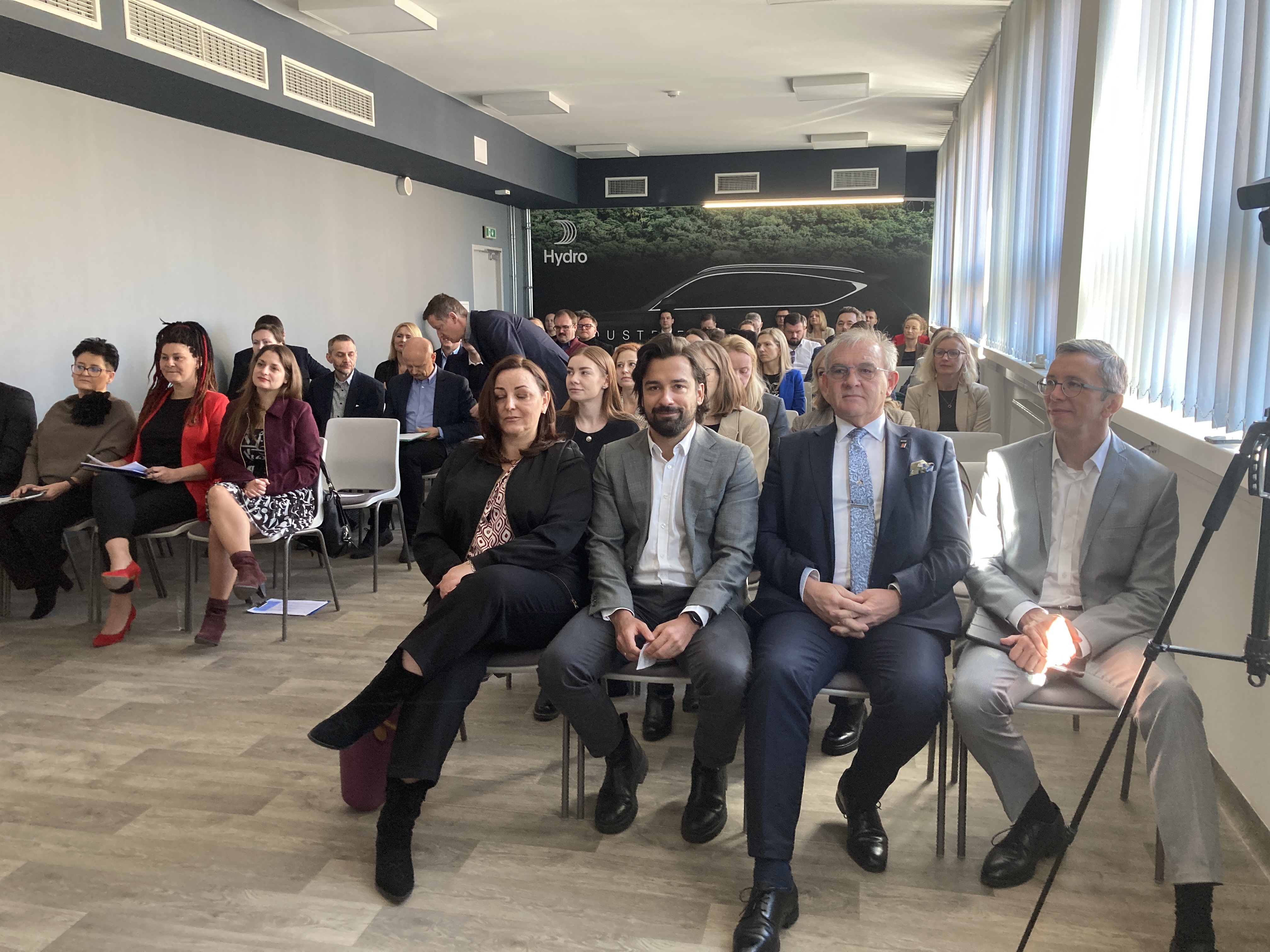
Group involved in the preparation and presentation of the report
Competences as the foundation of growth
The key to change lies in competences for the industry of the future. Technology is available, entrepreneurs emphasized, but there’s a shortage of specialists who can implement it effectively. The region needs experts in PLC programming, robotics, production line integration, data analysis, cybersecurity, energy, and circular economy — as well as leaders capable of managing change. The foundation is already in place: an extensive network of vocational schools and training centres. The challenge now is to align them even more closely with real industrial needs.
A strategic direction for the city
The report is more than just a diagnosis. It serves as a roadmap for further strategic action by the City of Lodz in the area of economic development. It shows that Lodz has the potential to become one of Poland’s leading centres of advanced industry — provided it evolves from a dispersed structure into an integrated ecosystem based on cooperation among business, academia, and local government, combined with investment in competences and a systemic approach to digital and green transformation.
The report’s release marks the beginning of a process, not its conclusion. The second part of the study, planned for 2026, will deepen the analysis and more precisely define directions for supporting the growth of modern industry. Lodz is clearly signalling: the Industry X.0 transformation is a long-term strategy, not a one-off project.
Report authors:
From the Faculty of Organization and Management, Lodz University of Technology – Dr. Assoc. Prof. Anna Adamik, Assoc. Prof. Karol Klimczak, and Assoc. Prof. Anna Walecka
From the Faculty of Electrical, Electronic, Computer and Control Engineering - Anna Kubczak, PhD, Franciszek Sobiech, MSc and Magdalena Wróbel-Lachowska, PhD.