
The event was held under the patronage of the Minister of Digital Affairs and the Minister of Development and Technology, which showed that the field of semiconductor technologies is becoming part of strategic development plans not only at the regional but also at the national level.
The inspiration for the meeting was the so‑called semiconductor policy based on the report prepared by the Ministry of Digital Affairs, “Poland in the Game for the Future: Policy for the Semiconductor Sector 2025+”, which the government plans to adopt in the second quarter of 2026. The Ministry of Digital Affairs aims for Poland’s semiconductor industry to become an important part of the European and global technology ecosystem, while Poland’s goal is to increase its share in global semiconductor value chains and to develop technological competences that will build a competitive advantage and strengthen the country’s technological sovereignty.
A strategic sector for Poland
The original main goal of the Lodz meeting was to create a shared space for discussion of the challenges and opportunities facing the semiconductor and advanced electronics sector. However, it became one of the most important events in the debate on the future of the semiconductor sector in Poland, which is of strategic importance not only for the region, but also for the country’s technology policy.
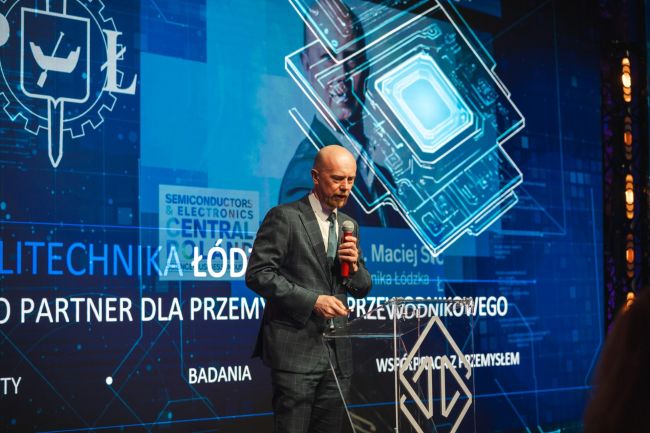
Semiconductors, the heart of modern technology, are currently one of the key components of the digital economy and next‑generation industry. They are used in everything from control systems, through the Internet of Things and artificial intelligence, to advanced defense systems, energy and automotive applications.
Debates of experts and politicians
In the Lodz debate of experts and politicians, during the institutional panel the President of the Lodz Special Economic Zone, Tomasz Sadzyński, stressed that “modern electronics and semiconductors are one of the key drivers of economic development”, and that Central Poland has huge potential also in the area of artificial intelligence and new technologies, which may help build the region’s competitive advantage on the national and European scale.
An important element of the discussions was also the aforementioned issue of the government strategy for the semiconductor sector. Deputy Minister of Digital Affairs, Dariusz Standerski, pointed out during the conference that this policy anchors specific cities, including Lodz, in the national action plan, but must be based on broad regional cooperation. In addition, Secretary of State at the Ministry of Development and Technology, Michał Jaros, emphasized that the Lodz Voivodeship has a “strong scientific and industrial base”, which makes it attractive for locating investments in the semiconductor and electronics sectors. He also underlined that semiconductor production in Poland is “a matter of Polish national interest”, drawing attention to the enormous potential of more than 50,000 software companies, which in itself forms a foundation for the development of this sector.
The Rector of Lodz University of Technology, Prof. Krzysztof Jóźwik, stressed that the university intends to actively co‑create the semiconductor ecosystem by developing research, educating highly specialized staff and maintaining close cooperation with industry, seeing in this an opportunity to strengthen the region’s position in advanced technologies.
The city authorities, represented by First Deputy Mayor Adam Pustelnik, and the regional self‑government, represented by the Deputy Marshal of the Lodz Voivodeship, Piotr Wojtysiak, likewise highlighted the ambition of Lodz and the Lodz region to become one of the key sector hubs in Poland, pointing to locational advantages, the academic base and readiness to create conditions conducive to investment and the development of a regional semiconductor cluster.
Letter of intent
One of the important outcomes of this part of the conference was the signing of a letter of intent by the authorities of Lodz, the regional self‑government of the Lodz Voivodeship, the Lodz Special Economic Zone and the academic community to support the development of the semiconductor sector in the region and to prepare the ground for creating a specialized technology park. This is the first concrete step towards building infrastructure that can attract global investors and foster the creation of a value chain from design and research through to industrial‑scale production.
Integration and cooperation
During the industry debate it was emphasized that the development of the semiconductor sector requires not only central‑level policy but also integration of local communities – academic, business and self‑government. The concept of building a technology cluster for Central Poland emerged in the discussions as a way to tighten cooperation and mutually complement the competences of regional actors. This integration is intended to support knowledge exchange, multiply the effects of scientific research, enable joint applications for European funds and build the region’s recognition as a place that is attractive for high‑tech investments.
Entrepreneurs pointed out the need for closer cooperation with universities and public administration so that research results can be translated more quickly into implementations and so that competences can be developed that respond to market requirements. Attention was also drawn to the importance of stable and predictable instruments for supporting investment and developing local supply chains, which, in the context of global tensions, has not only an economic but also a strategic dimension. Initiatives of this kind fit both the objectives of the national semiconductor policy and the EU’s European Chips Act strategy, which aims to strengthen Europe’s production base and technological independence by 2030.
In the discussions it was stressed that Poland already has competitive assets – numerous technical universities, a highly qualified engineering workforce and companies operating in integrated circuit design, photonics and electronic systems, which together form a solid basis for further growth. Industry reports and analyses indicate that the country has the potential to become a key element of the European value chain in microelectronics, particularly in the areas of design, advanced research and technology integration, while the proximity of large investments in Central Europe further increases the attractiveness of Polish locations.
The meeting in Lodz showed that discussion about semiconductors is no longer a purely technical topic confined to laboratories but is becoming part of strategic economic planning and regional development. This is particularly important in the context of global technological competition and challenges related to the supply of components that are crucial for digital transformation in every area of social functioning. The joint discussion, which brought together representatives of administration, business and science, demonstrated that building an effective cluster and integrating the sector at the regional scale is not just an aspiration but a real process aimed at creating lasting cooperation links and joint projects that can accelerate the sector’s development.
As a result, the “Semiconductors & Electronics Central Poland” conference became more than just a presentation of regional potential. It was a genuine community‑wide debate on the future of the semiconductor sector in Poland, on government strategies to support it, on the need to integrate the sector and leverage regional strengths, and on the first steps towards building a strong technology ecosystem in Central Poland. Its message is clear: only through cooperation between administration, business and science will it be possible to make effective use of the opportunities offered by the global technological transformation.