


What challenges are encountered in designing polymer coatings?
I think the biggest one is finding a compromise between many material properties. We want a coating to be durable, flexible, and resistant to various factors such as temperature, humidity, or chemicals, while also being environmentally safe.
There is also a growing expectation that materials will do more than just provide protection—for example, they should respond to temperature or release specific substances. This makes the design of modern polymer coatings increasingly interdisciplinary and opens up many possibilities for creating innovative solutions.
Why did you choose this research topic?
The idea came from an interest in materials that not only serve a structural function but also respond to external stimuli. Elastomer composites (e.g., rubber, silicone, polyurethane) are particularly interesting in this respect because their properties can be modified by selecting appropriate components and additives. In my research, I was especially interested in combining the high elasticity of rubbers with additional functions, such as changing color under temperature influence or potentially releasing active substances. This makes an ordinary material become a “smart” material.
How would you explain this topic in the simplest way?
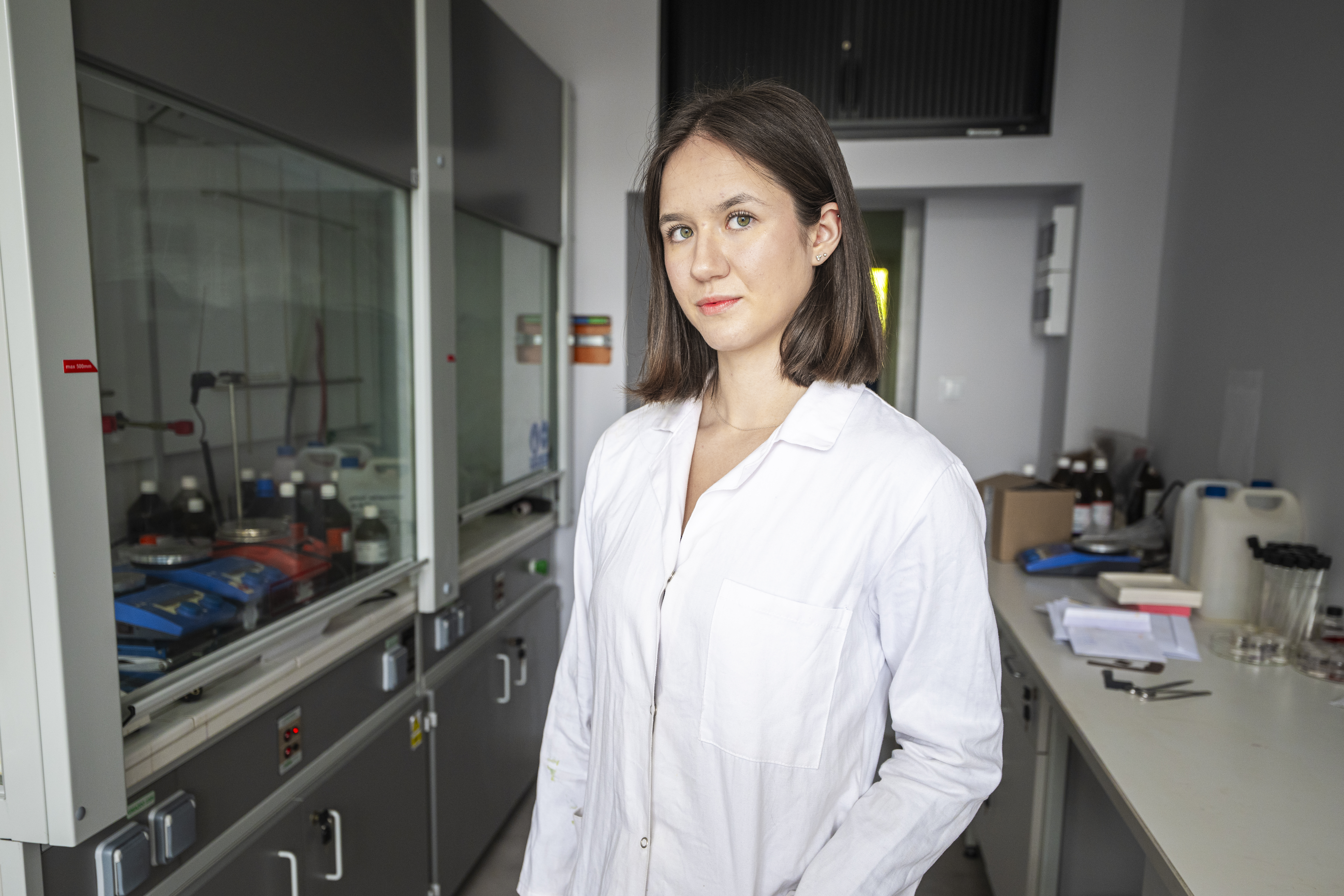
In my research, I design elastomer composites based on natural and synthetic rubbers. I analyze how individual components affect material properties and how they can be modified to achieve specific functional features. I pay particular attention to using natural rubber as a renewable resource and to the possibility of creating materials with additional functions, such as temperature-induced color change or interaction with fragrance and biologically active substances. As a result, traditional elastomers can
become smart materials that respond to modern technological and environmental challenges, such as reducing the use of non-renewable resources, improving safety, monitoring device condition, or preventing the growth of microorganisms. Materials that respond to temperature changes can signal overheating, while composites containing biologically active substances may be used in systems that improve hygiene and air quality.
What are the benefits of combining natural and synthetic rubber with silica?
It allows us to take advantage of the strengths of both materials. Natural rubber provides very good mechanical properties and high strength, while synthetic rubber allows better control of resistance to external factors. Silica acts as a reinforcing filler. It affects stiffness, strength, and the behavior of the material during use. By selecting the right proportions, materials can be designed with properties tailored to specific applications.
What are swelling tests?
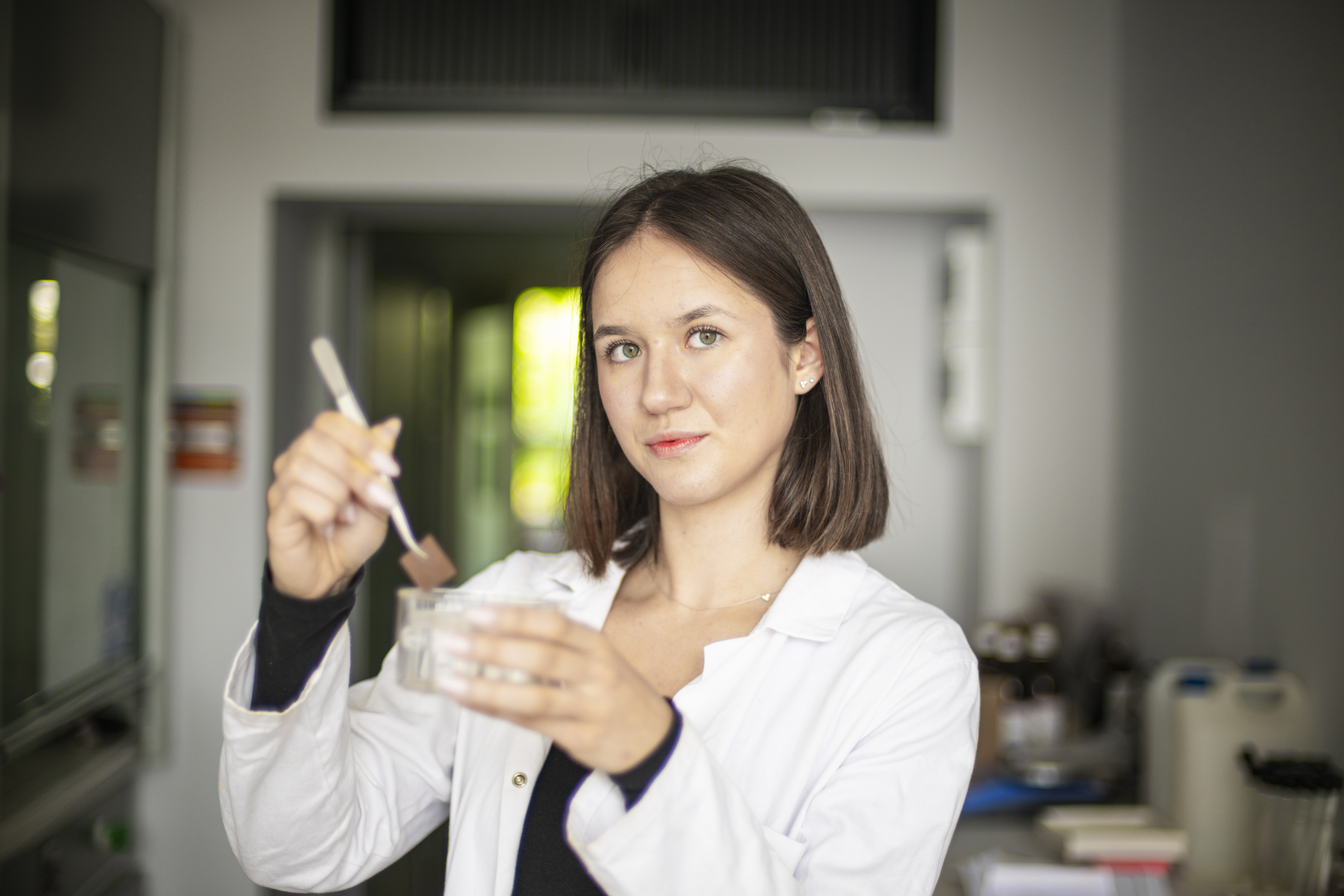
They involve immersing samples in different solvents and observing how much their volume or mass increases. This is a very valuable method because it allows us to assess the degree of cross-linking in the material and its chemical resistance. The less a material swells, the more compact its structure usually is. These tests help better understand how the type of rubber or the silica content affects the properties of the composite.
Your materials can change color—how does the thermochromic effect work?
It involves a change in the material’s color under the influence of temperature. In practice, this means the material can visually signal changes in environmental conditions. Such solutions can be used, for example, in smart temperature indicators, warning materials, or components that monitor device overheating. It is an example of a material serving not only a mechanical but also an informational function.
There is also a scent-related aspect in the project.
Microencapsulation involves enclosing active substances, such as essential oils, in microscopic capsules that protect them from rapid evaporation. In principle, the capsules can release their contents under specific stimuli such as friction, pressure, or temperature. In our project, we made initial attempts at microencapsulating fragrance substances, but it turned out to be a much more complex issue than expected. Work in this direction will continue in future research stages. We already know, however, that essential oils themselves affect the properties of the resulting materials and also exhibit interesting bacteriostatic effects. This aspect is currently being analyzed in detail.
Where can such “smart” materials be used?
The range of applications is very broad—from the automotive industry, packaging, and medicine to the production of modern consumer goods. A particularly interesting direction is air conditioning systems, both in cars and buildings. In practice, these installations are often not cleaned regularly, which promotes the growth of bacteria, fungi, and other microorganisms responsible for unpleasant odors and reduced air quality. Elastomer composites containing properly selected essential oils could in the future serve as special inserts or components in such systems. Thanks to their bacteriostatic properties, they could limit the growth of microorganisms while gradually releasing a pleasant scent, improving user comfort. This is currently one of the concepts being developed based on the obtained results regarding the influence of essential oils on material properties.

What surprised you the most?
The challenge turned out to be combining different fields of science within one project. The research includes chemistry, materials engineering, as well as issues related to biological properties and the analysis of active substances. It taught me patience above all and that in science not every assumption immediately brings the expected results. Sometimes equally valuable information is that a given method requires further modification. Thanks to this, I gained not only laboratory knowledge but also experience in analyzing results, solving research problems, and working in a team with scientists representing different specialties.
Interview by Agnieszka Garcarek-Sikorska