
What word or image best captures the distinctive character of the Faculty?
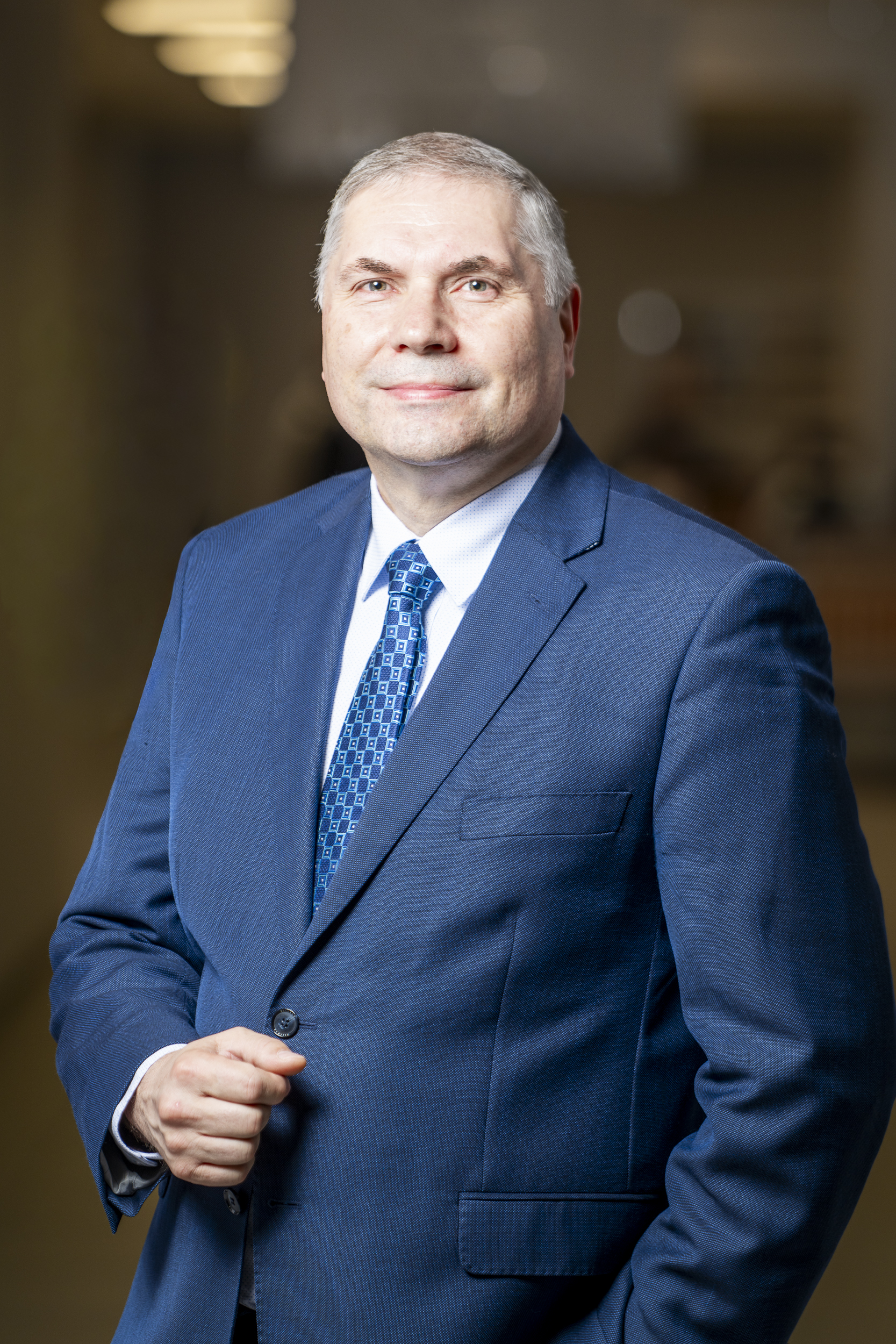
Assoc. Prof. Robert Sarzała: When I think of our community, the word that comes to mind is foundation. Students gain a well-rounded education here, grounded in physics, mathematics and computer science – disciplines that underpin almost every new technology. Most importantly, however, we teach not only knowledge but also a way of thinking: analysing logically, identifying relationships and drawing conclusions. These skills remain valuable throughout a person’s working life.
This starts earlier, while pupils are still at secondary school. The Faculty is actively involved in supporting them directly.
We see building relationships with prospective students as one of our most important tasks. For many years, we have offered free training sessions for mathematics and physics Olympiads, classes preparing pupils for the computer science matura examination, and the MORE z PŁ admissions programme. These initiatives help pupils prepare more effectively for university while also allowing them to earn additional admissions points or even secure admission to selected degree programmes.
We particularly value direct contact with young people. Before the pandemic, the Faculty welcomed as many as around two thousand school pupils each year for popular science lectures, demonstrations and laboratory classes. Although these events are now held on a smaller scale, we still regularly invite pupils into our laboratories and lecture rooms, giving them an inside view of science. Sharing information about our cooperation with schools, Olympiad training and science outreach remains an important part of the Faculty’s activities.
Which of these activities do you consider the most effective?
I think, however, that something else matters most. We aim not only to encourage young people to study at our Faculty but, above all, to spark their curiosity about the world and their enthusiasm for mathematics, physics and computer science. Many participants in our classes later return to Lodz University of Technology as students, and some go on to join our doctoral community and staff.
The Faculty combines physics, IT and mathematics – how does this interdisciplinary mix give graduates an advantage in the job market?
Our strength lies in the fact that we do not simply teach students how to use IT tools. We aim to educate people who can understand and describe complex phenomena, and then translate that knowledge into IT solutions. This combination of mathematics, physics and computer science enables our graduates to thrive in areas where programming alone is no longer enough, such as industrial process modelling, data analysis, artificial intelligence, photonics, electronics and the digital technologies of tomorrow. They are therefore equipped not only to use existing technologies but also to help create them. It is also worth stressing that an understanding of the laws governing technological and natural processes is highly valued by employers, as it enables graduates to work effectively across disciplines – precisely where the most innovative solutions emerge.
What are the main areas of research?
It is difficult to answer that question in a single sentence, given the nature of the Faculty, which comprises three fairly autonomous institutes. I will therefore try to outline the key research areas in each.
At the Institute of Physics, research focuses on computational methods for describing atoms, molecules and new materials. Researchers develop advanced computational tools used worldwide to design drugs, functional materials and modern technologies. Their research also includes modelling processes occurring in living organisms and developing solutions to support medicine, including implants that reduce the risk of infection by antibiotic-resistant bacteria. Another important research strand at the Institute is photonics and semiconductor optoelectronics. Research focuses primarily on advanced VCSEL lasers, integrated photonics, subwavelength structures, and applications of photonics in neuromorphic computing and artificial intelligence. Key achievements include work on new semiconductor laser architectures, the use of wave chaos for information processing, and the development of photonic integrated circuits. This research has applications in areas including optical telecommunications, space technologies, environmental monitoring, sensing systems and artificial intelligence.
At the Institute of Information Technology, key research focuses on the development of artificial intelligence methods, machine learning and data analysis. This encompasses image, signal and natural language processing, intelligent decision-support systems, and applications of AI in science, medicine, business and industry. A second area is research into games technology and computer graphics, including animation, virtual and augmented reality, and interactive digital environments used in entertainment, education and industry.
At the Institute of Mathematics, the leading research area is the application of mathematics in medicine, finance and insurance, helping to anticipate and solve real-world problems. On the one hand, we develop models that help doctors tackle cancer, Alzheimer’s disease and sarcopenia more effectively, and we forecast the spread of epidemics, taking migration and armed conflict into account. On the other, our researchers develop modern tools in risk theory, translating advanced mathematical theories into greater health and financial security for us all.
A great deal has happened over the Faculty’s 50 years, an anniversary you are now celebrating. Which events were pivotal?
The history of our Faculty is one of steady development and the successful integration of different scientific disciplines. Its origins can be traced back to 1970, when two important units were established: the Institute of Physics, organised by Dr Jan Karniewicz, and the Interfaculty Institute of Mathematics, founded at the initiative of Professor Izydor Dziubiński. These provided the foundations on which today’s Faculty was built.
Another turning point came in 1976, when the two institutes merged to form the Faculty of Technical Physics and Applied Mathematics. Just three years later, in 1979, the Faculty’s first students graduated, confirming the success of the new unit and its educational provision.
The incorporation of computer science into the Faculty’s structure was another major stage in its development. In 1980, the existing Electronic Computing Centre (OETO) was transformed into the Institute of Information Technology, headed by Professor Edward Kącki. The Institute subsequently became part of the Faculty in 1994. That year also saw the first intake of students onto the computer science degree programme, and the Faculty adopted the name it retains today: the Faculty of Technical Physics, Information Technology and Applied Mathematics.
The new unit found its place on Campus B.
In 2004, the so-called Three Faculties Building opened. It was the first former industrial building adapted by Lodz University of Technology for teaching purposes, marking the start of the regeneration of the University’s post-industrial sites. Another milestone came in 2015, when the Faculty acquired modern premises in a regenerated former industrial complex. This investment created excellent conditions for both research and teaching.
Looking back over half a century, we can identify three processes that were crucial to the Faculty’s development: bringing physics and mathematics together, subsequently incorporating computer science, and creating modern research and teaching infrastructure. These decisions enabled the Faculty to grow into a strong, interdisciplinary academic centre. Today, it educates nearly 1,500 students across seven degree programmes, combining a long-standing tradition with a forward-looking approach to science and technology.
The Institute of Physics is very active in grant-funded research and enjoys an international reputation. What makes it stand out?
Above all, it is the people. We have a relatively young, ambitious and highly active team of researchers whose work is driven by passion and genuine curiosity about the world. One indication of this is that around 20 research grants were being carried out here over the period 2022–2026 – almost as many as the total number of our academic staff working in the physical sciences.
Another strength is our ability to combine fundamental research with topics of considerable practical importance. Our research ranges from the foundations of physics, quantum chemistry and mathematics, through photonics and advanced materials, to issues relating to artificial intelligence, medical technologies, and the design of new drugs and biomaterials.
The international nature of our work is equally important. We collaborate with leading research centres and technology companies in Europe, Asia and the United States. Our staff lead international research teams, are invited to take part in prestigious research programmes, and receive the highest honours in their fields.
What arguments might persuade prospective students to choose theoretically focused fields of study?
I would tell school-leavers that you can learn to use tools in a few months, but a deep understanding of phenomena and the ability to think analytically take much longer to develop. Theoretically focused fields of study build a foundation for subsequent development in many directions: from artificial intelligence and data analysis to advanced materials technologies, photonics and sophisticated computer simulations.
Paradoxically, theoretical knowledge is becoming more valuable in the age of artificial intelligence. Ready-made tools are becoming easier to use, but the ability to ask the right questions, assess results critically and create new solutions is becoming ever more valuable. That is precisely what theoretically focused degree programmes teach. Rather than preparing students for one specific job, they provide skills that will help them navigate their entire working lives, often over a very long career.
Interview by Agnieszka Garcarek-Sikorska