The event, which took place on 17 October, attracted around 650 people to the sports and entertainment hall of the Sports Bay at Lodz University of Technology – mainly students and doctoral students, as well as university staff.
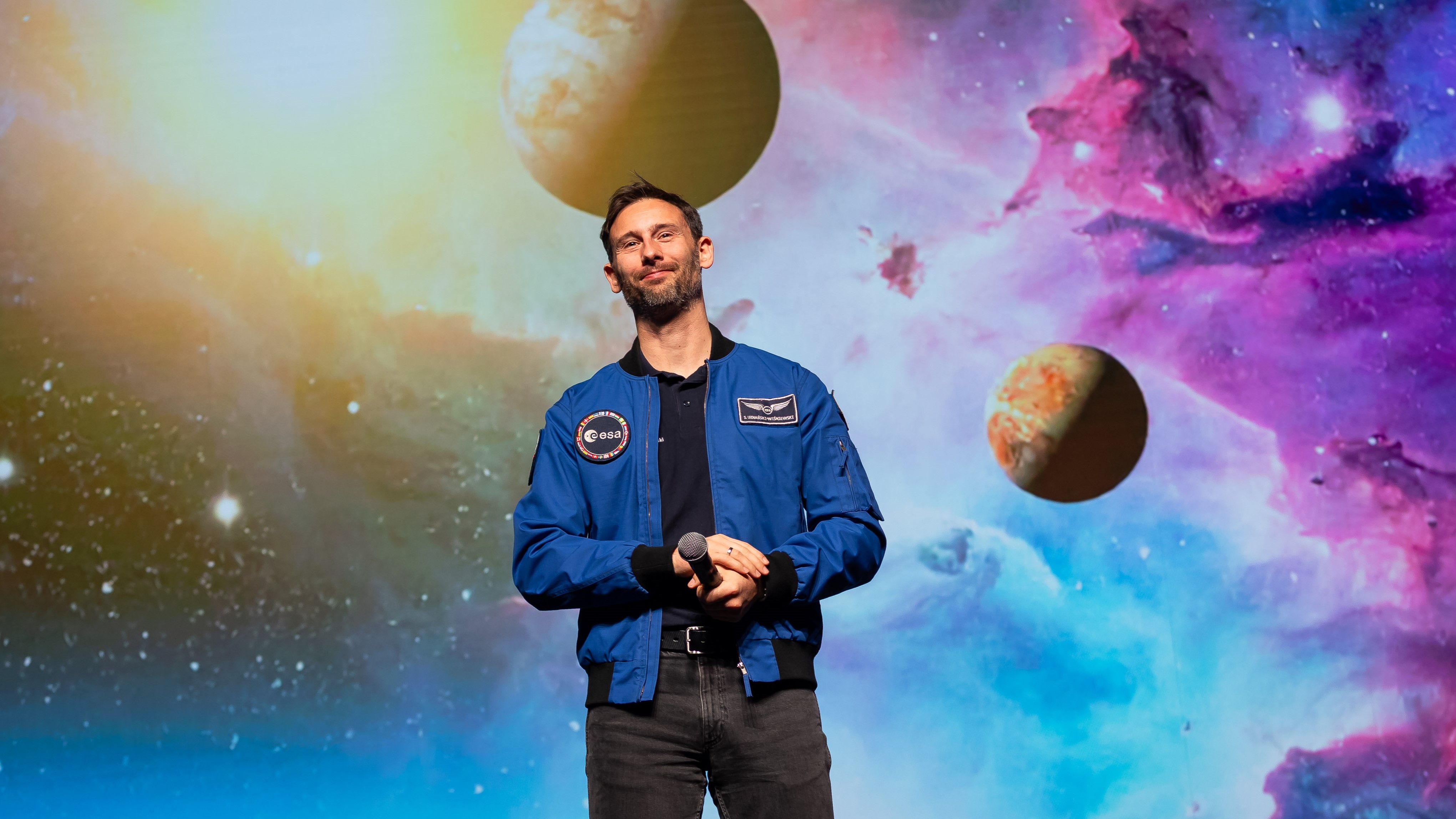
The Rector of TUL, Prof. Krzysztof Jóźwik, opened the event by emphasising the uniqueness of this visit: "It is with great pride that we welcome today a graduate of Lodz University of Technology – Dr Sławosz Uznański-Wiśniewski. This is a historic event, as we have the first Pole in our community who has been to the International Space Station. It is safe to say that it is his brilliance that has attracted crowds of students, doctoral students and scientists from six universities in Łódź today. I am very happy that there is such keen interest in the IGNIS mission.”
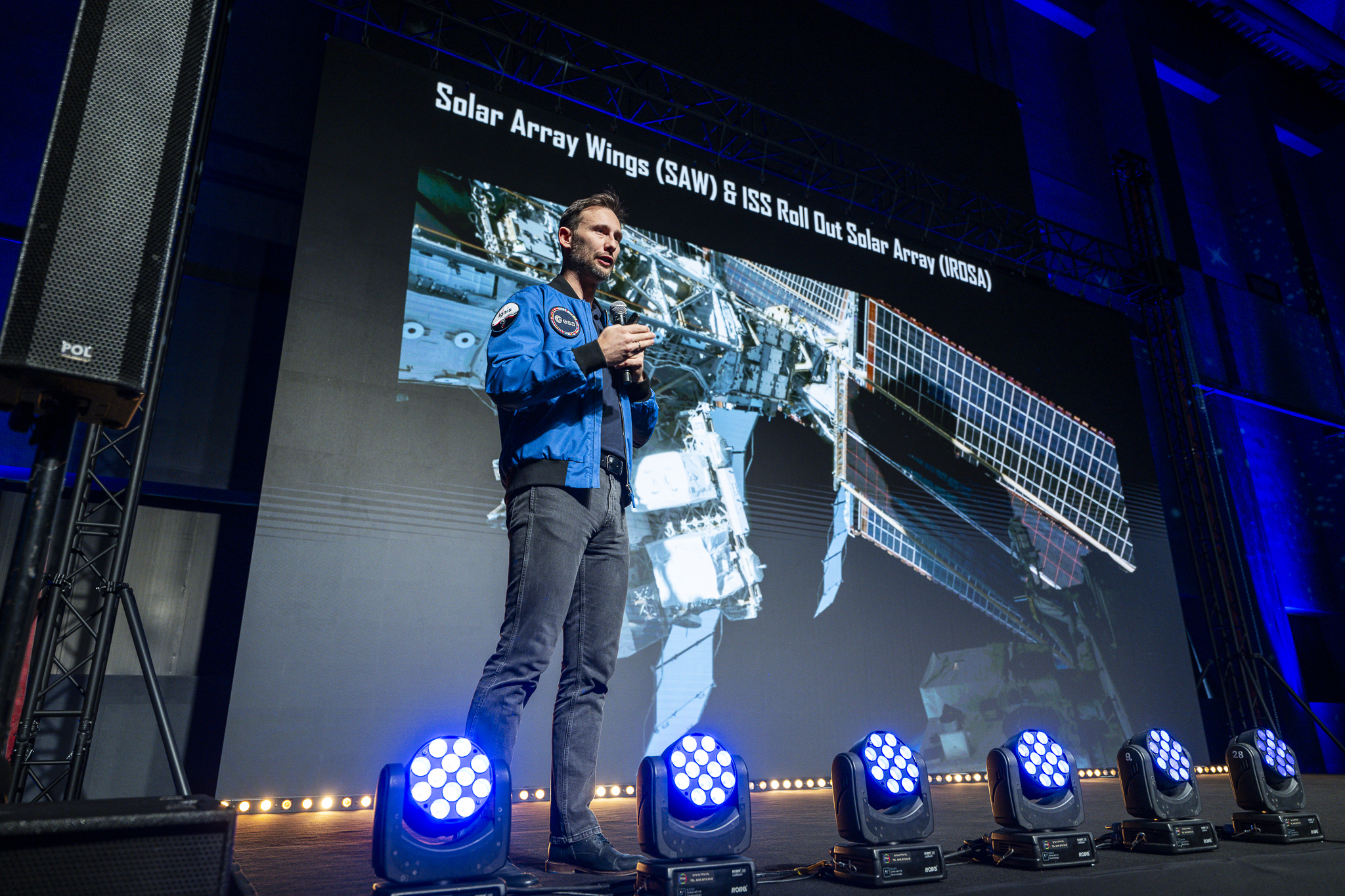
Dr inż. Uznański-Wiśniewski spoke about his path to the European Space Agency, preparations for the mission and the everyday life of an astronaut in orbit. The lecture, which was more technical in tone, was full of passion and commitment – the astronaut vividly described the functioning of the space station, the behind-the-scenes of scientific experiments conducted in microgravity conditions, and his own experiences of life on board the International Space Station. Thanks to his stories, it felt as if we were there with him.
During the event, Dr Sławosz Uznański-Wiśniewski was honoured with the title of ‘Outstanding Graduate of Lodz University of Technology’. Prof. Krzysztof Jóźwik, Rector of TUL, recalled: ‘I have already had the pleasure of presenting you with the statuette of the ’Space Graduate’. Today, the time has come to rename it the title of ’Outstanding Graduate".
A moment later, Sławosz Uznański, presenting Rector Jóźwik with a special certificate bearing the IGNIS logo and the Polish flag that had been in space, stressed the symbolic meaning of the project's name. ‘IGNIS means “fire”, and we in Poland have a lot of energy and passion – that inner fire that fuels curiosity about the world and encourages us to ask questions,’ he said. He added that curiosity and a desire to learn are among the most important qualities and motivations for action.
Participants also had the opportunity to listen to presentations on two experiments conducted as part of the IGNIS mission. The first, called EEG Neurofeedback, concerned the study of neurofeedback in reducing stress and improving efficiency in conditions of extreme isolation. It was conducted by a team from the Academy of Physical Education and Sport under the leadership of Prof. Marcin Dornowski. The second project, presented by Dr Mateusz Stojko from the Centre for Polymer and Carbon Materials of the Polish Academy of Sciences, was called Stability of Drugs and concerned the testing of polymer systems that extend the shelf life of drugs in space conditions.
After the presentations, there was a question and answer session, which was eagerly awaited by the academic community. There were many questions, which best demonstrates how much interest the meeting generated. The students asked questions about technical issues, such as protection against cosmic radiation and the body's adaptation to microgravity conditions, as well as more personal experiences of the astronaut, his motivations and advice for those who dream of working in institutions such as CERN.
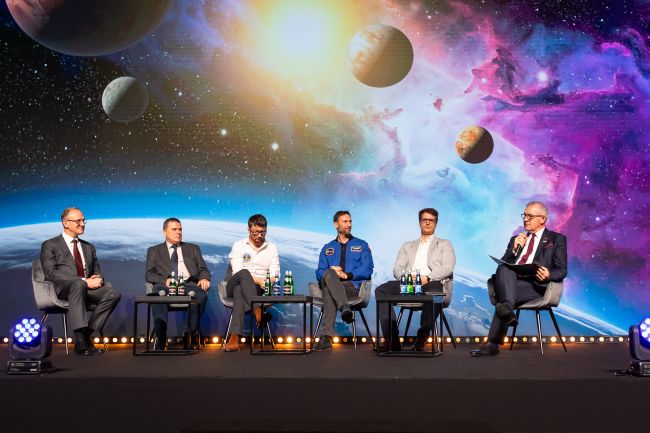
The expert panel discussion, moderated by TUL Rector Prof. Krzysztof Jóźwik, was extremely interesting. The panel participants included: Dr Sławosz Uznański-Wiśniewski, Prof. Marcin Dornowski, Dr Jakub Włodarczyk, coordinator of the Stability of Drugs experiment, Rector of the Medical University of Łódź, Prof. Janusz Piekarski and Prof. Tomasz Gwizdałła, Dean of the Faculty of Physics and Applied Computer Science at the University of Łódź.
The astronaut visited the research clubs. He talked to the students with genuine interest, listening to what they are currently working on, what solutions and ideas they plan to implement, and what experiences they have already had. Recalling his studies at Lodz University of Technology, he highlighted that it was here that he gained a solid foundation of theoretical knowledge and that, in his opinion, the key to learning is to constantly deepen one's knowledge, ask questions and consistently seek answers in order to find solutions to pressing problems.
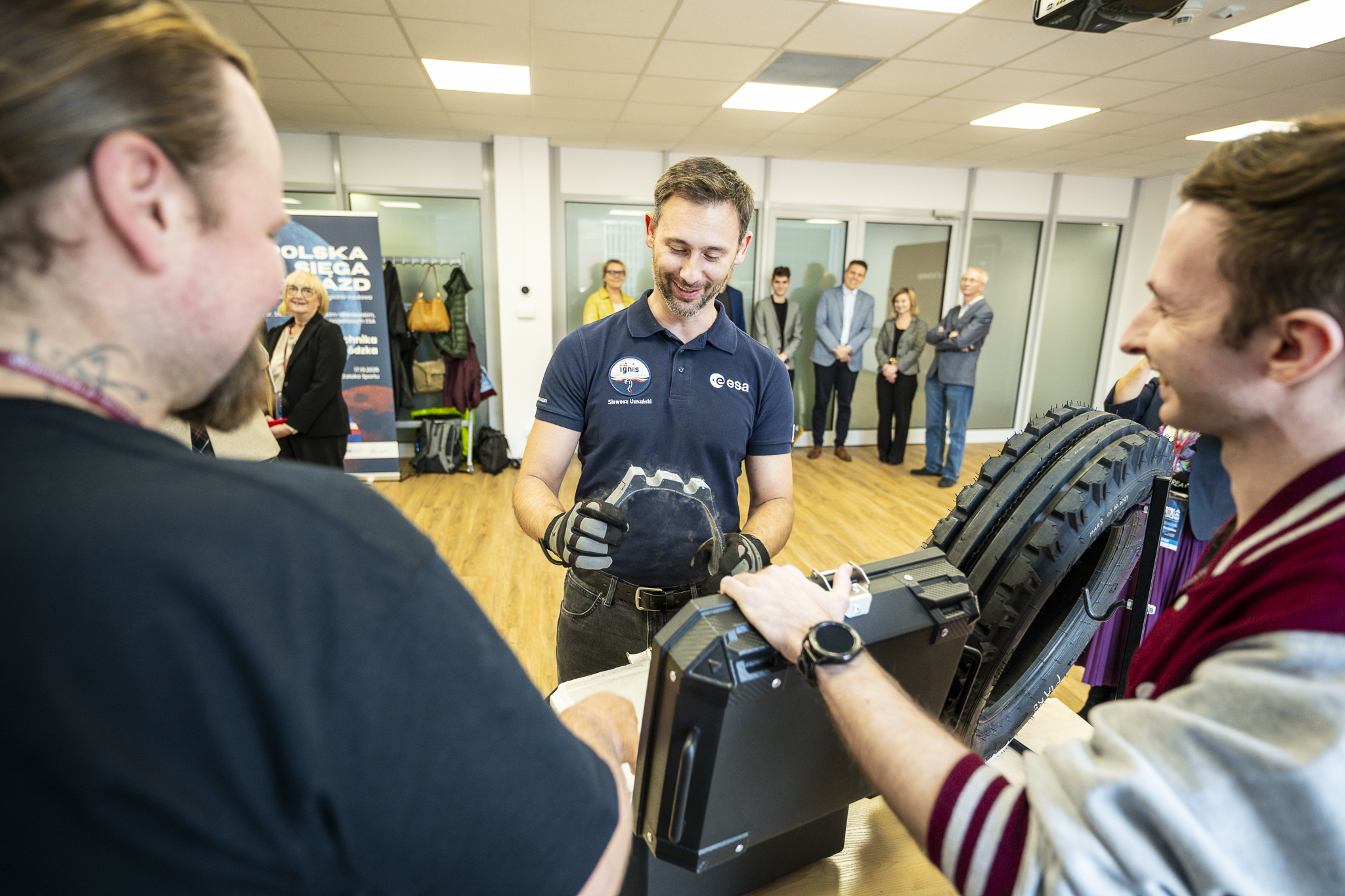
The next stop on the visit was an educational block for primary and secondary school pupils, which took place at ‘Alchemium – the magic of tomorrow's chemistry’. The programme included popular science activities and a meeting with an astronaut, during which the unique bond between the youngest participants and the astronaut was clearly visible and palpable.
‘IGNIS – Poland Reaches for the Stars’ is a joint initiative of the Ministry of Development and Technology, the Ministry of Science and Higher Education, and the Polish Space Agency (POLSA). Its aim is to popularise space science and technology, as well as to inspire young people to choose career paths related to science and engineering.