
PhD in physical sciences
priority research area: SecurityTech
Scientific achievements
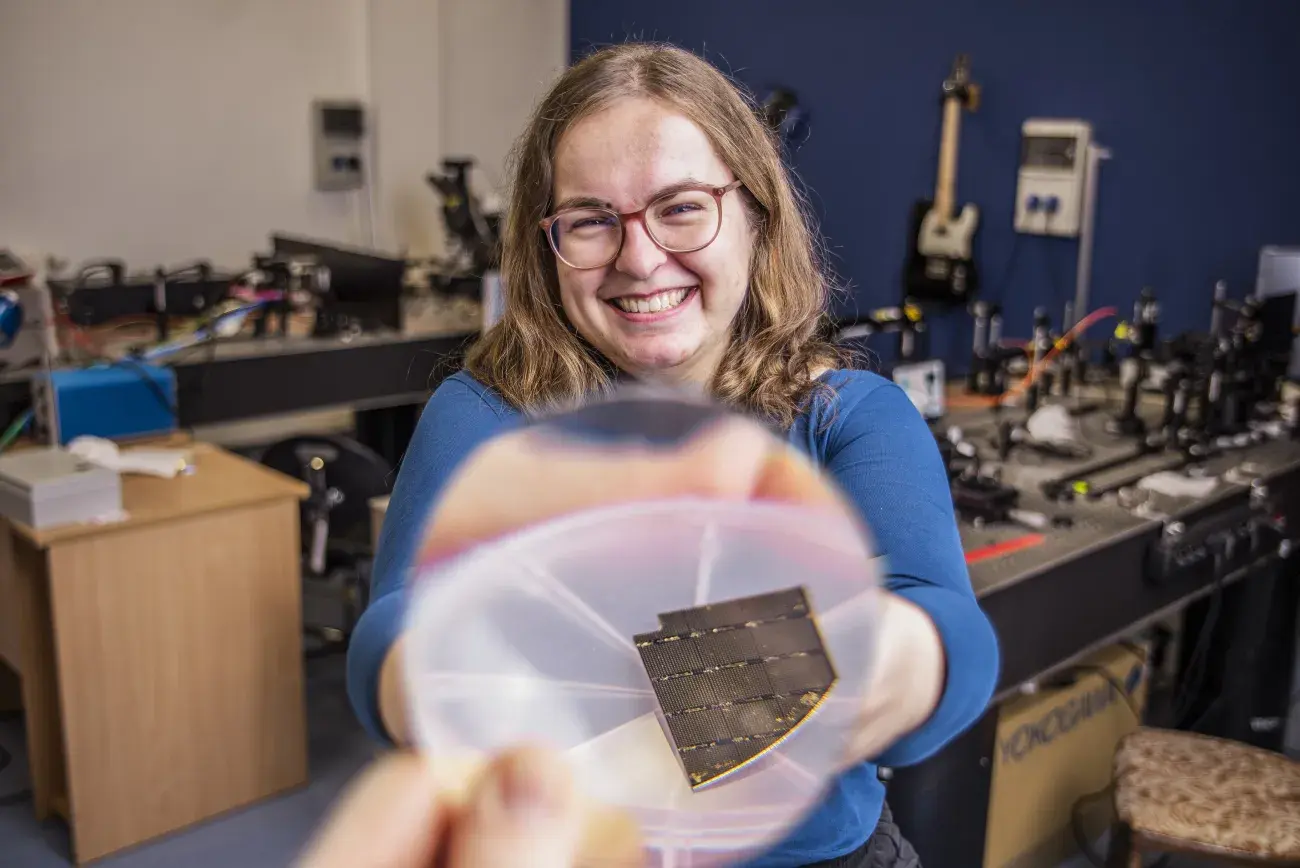
Magdalena Marciniak, PhD, Eng., is a young scientist in the discipline of physical sciences, who received her doctorate in 2022. Her most important scientific achievements include participation in the development and characterization of Vertical-Cavity Surface-Emitting Lasers (VCSELs) with broken cylindrical symmetry. These structures allow for increased output power and control of optical mode distribution compared to conventional designs. Her publications include 31 papers in international journals from Q1, such as Laser and Photonics Reviews, IEEE Photonics Journal, ACS Photonics, Optica, Applied Surface Science and Optics Express. More than 60% of these publications were produced as a result of international cooperation with group from the Technische Universität Berlin and thanks to NAWA scholarships at IFISC (Spain) and FEMTO-ST (France)c. In 2025, she organized the international conference VCSEL Day, which shows her growing activity in world science.
Research profile
Her research is in the field of advanced semiconductor photonics, featuring VCSELs and subwavelength structures enabling precise control of optical properties of optoelectronic components. She designs monolithic subwavelength gratings with high refractive index contrast and studies their effect on the emission and spectral characteristics of light sources. She develops unconventional laser geometries, including structures with broken cylindrical symmetry and apertures inspired by wave chaos phenomena. The researcher also explores the possibilities of using these solutions in information processing systems, as optical neuromorphics networks, where photonic structures can act as computational elements. She exhibits a high potential for the development of new generations of components for detection and communication systems.
Design experience and cooperation with industry
She is the principal investigator of the NCN Sonata grant (2025–2028) „VCSEL lasers with broken symmetry: increasing efficiency and reaching new frontiers in semiconductor laser technology”, carried out in cooperation with the Wrocław University of Science and Technology and Łukasiewicz-IMIF. Previously, she led the NCN Preludium project (2019–2024) on the use of semiconductor lasers in the detection of gases and liquids. Both projects are funded by the National Science Centre. She cooperates closely with the industry: TRUMPF Photonic Components GmbH,VIGO System S.A. and others. She participates in the design and
characterization of lasers for LiDAR systems, optical sensors and data transformation.