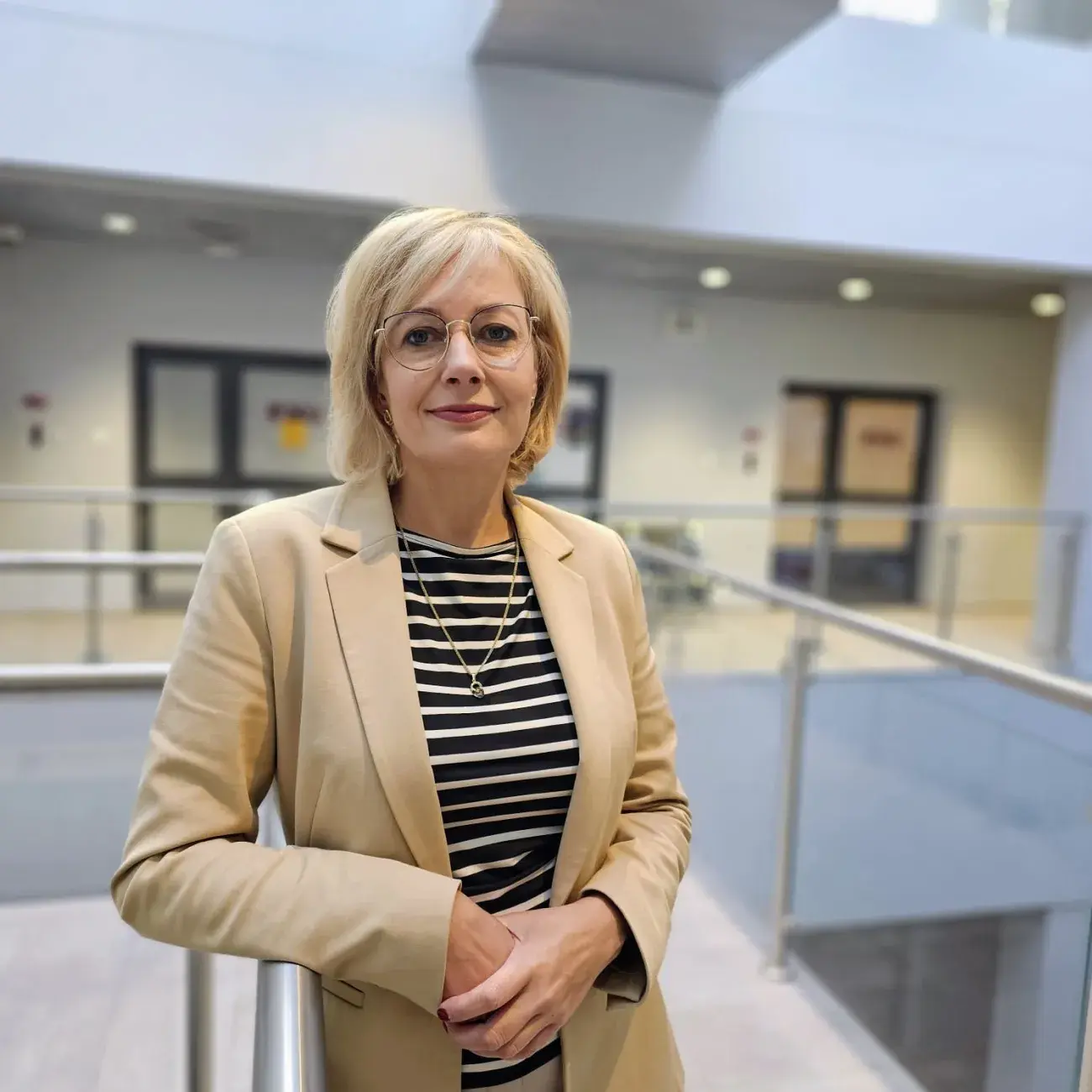
professor in the scientific discipline of chemical engineering
priority research area: MoleculeTech
Scientific achievements
Professor Hanna Kierzkowska-Pawlak from the Faculty of Process and Environmental Engineering at Lodz University of Technology is a specialist in chemical engineering, plasma technologies, catalysis, and CO₂ capture and conversion processes. Her scientific output includes 53 publications listed in the JCR.
Research profile and research directions
Her scientific interests include plasma technologies, the design and fabrication of thin-film nanocatalysts using PECVD, plasma modification of material surfaces, and catalytic capture and conversion of carbon dioxide. Together with the team from the Division of Molecular Engineering, Professor Kierzkowska-Pawlak develops research on nanohybrid catalysts based on transition metal oxides, whose activity and selectivity are governed by electronic interactions near phase boundaries and associated semiconductor heterojunction effects at the nanoscale.
Among her most significant achievements is the co-development of a concept explaining the activity of nanohybrid catalysts based on the classical theory of semiconductor heterojunctions. The team's studies revealed that, at the nanoscale, space charge regions may extend throughout the entire volume of nanoparticles, fundamentally determining their catalytic properties. These findings also highlight the potential of cold plasma as a tool for the controlled formation of heterostructures, supporting the rational design of multicomponent catalysts for CO₂ conversion.
Honours and recognition from the scientific community
Professor Kierzkowska-Pawlak participated in an OPUS (NCN) project devoted to new nanocatalytic structured packings for carbon dioxide hydrogenation. She also served as a project leader and coordinator of projects carried out in cooperation with ORLEN Asfalt concerning the use of catalytic processes in asphalt materials to convert harmful atmospheric compounds. She is a co-author of a patent concerning a method for producing a thin-film cobalt catalyst on structured reactor packings for CO₂ methanation, as well as patent applications related to catalytic ozonation of wastewater using heterogeneous thin-film catalysts.
Her scientific activity has a strong international dimension. She has collaborated with the Slovak Academy of Sciences and Shizuoka University in Japan, while her current research plans include further cooperation with Beijing Institute of Technology and Dalian Maritime University. She serves as Vice-Chair of the Committee of Chemical and Process Engineering of the Polish Academy of Sciences, is a member of the Advisory Team of the Minister of Science and Higher Education for the “Social Responsibility of Science” programmes, and acts as an expert for the European Commission under Horizon Europe and the European Innovation Council.